


Curves in the workplace are more than the latest design trend
Curves are everywhere in contemporary workplace design. Rounded walls, arched openings, curved banquettes, soft-edged meeting pods, circular rugs, sculptural ceilings and organic joinery have become increasingly common in offices, hospitality spaces and wellness-led interiors.
At first glance, it would be easy to dismiss this as another design trend.
But the growing use of curves in the built environment reflects something deeper than a stylistic shift. It connects to a broader understanding of how the human mind and body respond to space.
The workplace is not just a container for productivity. It is an environment that can influence focus, stress, collaboration, comfort and emotional wellbeing. Every spatial decision — from layout and lighting to materiality and geometry — contributes to the way people feel and behave throughout the day.
The Body Reads Space Before We Explain It
Humans do not experience interiors only intellectually. We respond to them physically, emotionally and neurologically.
Research into neuroarchitecture suggests that architectural experience involves several interconnected systems, including the way we interpret a space, the emotional value we attach to it, and the way it motivates us to move, approach, avoid, explore or stay.
This is important in workplace design because people are constantly reading their surroundings, often before they consciously analyse them. A space can feel calm, harsh, open, compressed, welcoming or intimidating almost instantly.
Geometry plays a role in that response.
Hard edges, sharp transitions and rigid spatial forms can communicate order and efficiency, but when overused, they can also create a sense of visual tension. Curves, by contrast, tend to feel softer, more approachable and more fluid. They can gently guide movement, reduce the sense of harshness and create environments that feel more human.
Why Curves Feel More Natural

The obvious assumption is that curves are found more often in nature, but this preference for organic forms can be measured in the human brain.
Natural environments are rarely made up of perfectly straight lines and hard corners. They are full of arcs, waves, branching forms, softened edges, layered contours and gradual transitions. When architecture introduces curvature, it can echo some of the visual language of the natural world.
Research into architectural interiors has explored geometric contour and found that curved interiors can activate areas of the visual cortex. Researchers have also hypothesised that people may prefer curved forms because they are more aligned with organic patterns found in nature.
This does not mean a workplace needs to look like a cave, a forest or a spa. The most sophisticated use of curves is often subtle.
A curved reception desk, a rounded meeting table, an arched threshold, a softened corner to a wall, a circular breakout setting or a gently curved circulation path can all shift the feeling of a space without making it feel overly themed or decorative.
Curves Can Support Approachability and Movement

In workplace environments, curves are particularly useful because they influence how people move through and interact with space.
A curved form can soften a transition between zones. It can draw people through a space without the abruptness of a hard corner. It can make a meeting area feel less confrontational. It can make a reception point feel more welcoming. It can help collaborative spaces feel more relaxed and less formal.
This matters because workplace design is no longer only about fitting desks into a floorplate. It is about supporting different modes of work: focus, collaboration, retreat, creativity, movement and informal connection.
Curves can help create a more intuitive flow between these modes. They can reduce visual friction and make a space feel easier to navigate.
In this way, curves are not simply an aesthetic feature. They can become part of the behavioural design of a workplace.
The Emotional Role of Soft Geometry
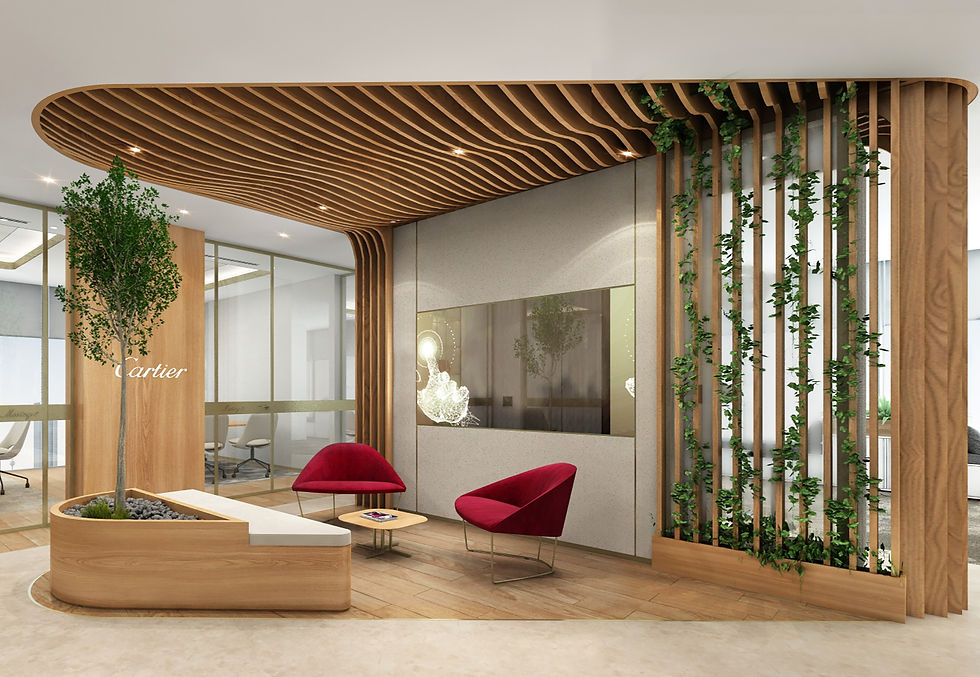
Wellness-focused workplace design also needs to consider how a space feels emotionally.
Studies into architectural experience identify emotional responses such as comfort, relaxation, stimulation, uplift, vitality and overall emotional valence as important measures of how people respond to interiors.
These qualities are highly relevant in workplaces, where people are expected to perform, communicate, problem-solve and regulate stress for long periods of time.
Curves can contribute to these emotional conditions by making a workplace feel less rigid and more supportive. A softened environment can help reduce the sense of institutional severity that many offices still carry. It can make shared spaces feel warmer, breakout areas feel more restorative and circulation zones feel less mechanical.
This does not mean curves automatically create wellbeing. Poorly applied, they can become gimmicky or impractical. But when used with intention, they can support a workplace that feels more calm, generous and human.
Curves, Safety and Social Comfort

Curves can also influence how safe or socially comfortable a space feels.
Sharp corners and abrupt junctions can create visual interruption. They can make spaces feel harder, more defensive or more rigid. Rounded forms tend to feel less aggressive. They soften the boundary between people and place.
In workplace settings, this can be especially valuable in areas where people come together: reception zones, meeting rooms, breakout spaces, waiting areas, wellness rooms and collaboration hubs.
A round table changes the social dynamic of a meeting. A curved banquette can create a sense of inclusion. A softened wall or joinery element can make a circulation path feel less pressured. These are small moves, but they affect how people experience the space in their bodies.
What This Looks Like in a Real Workplace
The practical application of curves in the workplace is not about adding arbitrary rounded shapes. It is about using geometry to support a desired human response.
Curves might be used to:
create a more welcoming arrival experience
soften circulation paths and improve intuitive wayfinding
make meeting spaces feel less hierarchical
support informal collaboration and conversation
reduce visual harshness in high-use areas
create a greater sense of calm in retreat or wellness spaces
echo natural forms without becoming literal or decorative
balance the rigidity of workstations, technology and commercial building grids
In a contemporary workplace, there will always be straight lines. Desks, walls, glazing suites, ceiling grids and building services often require order, structure and efficiency. The value of curves is not to replace that structure, but to soften it.
They create contrast. They introduce relief. They help the workplace feel less like a machine and more like an environment designed for people.

Beyond the Fad
Curves are fashionable right now, but their value does not come from fashion.
Their value comes from the way they can influence perception, movement, emotion and comfort. They can make a workplace feel more approachable, more natural, more fluid and more supportive of human experience.
When used thoughtfully, curves are not a decorative trend. They are part of a broader shift toward workplaces that understand the physiological and psychological relationship between people and the built environment.
A well-designed workplace should not only support productivity. It should support the people doing the work.
Reference
Coburn, A., Vartanian, O., Kenett, Y. N., Nadal, M., Hartung, F., Hayn-Leichsenring, G., Navarrete, G., González-Mora, J. L., & Chatterjee, A. (2020). Psychological and neural responses to architectural interiors. Cortex, 126, 217–241. https://doi.org/10.1016/j.cortex.2020.01.009


Comments